A few weeks ago, we jump-started the holiday shopping season with Black Friday and Cyber Monday. Like us, you probably browsed the shops and sites for the coolest products and best shopping deals for your holiday purchases. But if you're a business or an advertiser, you probably know that some of the biggest shopping weekends of the year are approaching — and you need to get your business ready for the rush!
If you're as geeky as we are, you're probably doing everything you can to figure out how to best use the tools available on the web to find the right customers and effectively measure the results from the money you spent on marketing.
At T-minus ten days before Christmas, its not too late to look over your holiday campaigns and we’d like to share with you our top 10 holiday tips — a quick checklist to help you make use of important data now and improve your holiday campaigns.
Consider it a gift from one geeky data whiz to another!
1. Update your wishlist:
Use the Search-based Keyword Tool to find keywords that you never thought of incorporating into your campaign for the holidays. (Here is a how-to guide for how best to use the tool: Monetize The Long Tail of Search).
2. Know what's hot this season:
Research on Insights for Search to see what the “Rising Searches” are and understand how people are searching for your brand (and your competitors!).
3. Read the wish lists:
Who could be looking for you? Type your website URL into Google Ad Planner to see who is looking for your site, broken down by demographic categories like age and gender.
4. Follow the reindeer:
Where else are they going? Use Ad Planner to find other websites that share the same demographics as yours. Putting display ads on that site might be a great way for you to target that audience!
5. Build new toys:
Create new AdWords campaigns for your holiday lines and products. Incorporate new keywords and keep in mind the trends you found on Insights for Search.
6. Train the elves:
Test your AdWords campaigns by introducing new holiday promotions. Then, test your promotions — a promotion for "30% off" might resonate better with your customers than "Buy One Get One Free."
7. Check your list twice:
Use Google Analytics to better understand where your traffic is coming from during the holiday season. Find out who's coming to your website, when they're coming and where they're coming from.
8. Map out the route:
How long are people staying on your website? Use Google Analytics to understand your purchasing cycle. Which pages have the highest bounce rate? And which pages are people leaving the quickest?
9. Test run on the sleigh:
Run experiments using Website Optimizer on the landing pages you have linked from your ads. Make sure the images are in the right place and that they're not a distraction for your customer. Play around with the size of the image and the image type.
10. Does the chimney work?:
Test different versions of your purchase page to find out what works best. Change the "purchase" button on your webpage. Pick different colors — bright versus dark colors — and vary the button sizes. Try out different text on your button. See which of these variations lead to the most clicks to conversions.
We wish you a happy, data driven holiday season.
Showing posts with label ads. Show all posts
Showing posts with label ads. Show all posts
Monday, December 14, 2009
A deep dive on display advertising
2009 has been a busy year for Google in the area of display advertising — that is, the image, video and interactive ad formats that run across the web.
Our goal is to improve display advertising on the web for everyone. We're working to help advertisers get better results from their display ad campaigns, enable publishers to make more money from their ad space and deliver better, more relevant ads (and, ultimately, more ad-funded web content) to users.
To achieve these goals, in 2009 we released a host of new features for display advertisers on the Google Content Network and on YouTube, launched the new DoubleClick Ad Exchange and made significant enhancements to our ad serving products.
On Tuesday December 15 at 10am PT, we're hosting an educational webcast for analysts, investors and press about our display advertising business. This is our second educational webcast — the first, on search advertising, was held in September.
The webcast will be available at investor.google.com, and a replay will be available on the same website. If you're interested in hearing about our efforts in this space, please feel free to tune in.
Our goal is to improve display advertising on the web for everyone. We're working to help advertisers get better results from their display ad campaigns, enable publishers to make more money from their ad space and deliver better, more relevant ads (and, ultimately, more ad-funded web content) to users.
To achieve these goals, in 2009 we released a host of new features for display advertisers on the Google Content Network and on YouTube, launched the new DoubleClick Ad Exchange and made significant enhancements to our ad serving products.
On Tuesday December 15 at 10am PT, we're hosting an educational webcast for analysts, investors and press about our display advertising business. This is our second educational webcast — the first, on search advertising, was held in September.
The webcast will be available at investor.google.com, and a replay will be available on the same website. If you're interested in hearing about our efforts in this space, please feel free to tune in.

Friday, December 11, 2009
Ad policies — the year in review
We’ve always said that a top priority for us is making sure that your search results are relevant, useful and safe. Of course, this commitment to a positive search experience extends to the ads you see on Google too. Earlier this week we took a stand to fight Internet scams, and in recent months, we've also put a new procedure in place to eradicate "scammy" ads. But that's not all we've done in the past year to help you get the best possible information from our ads.
Given that there are hundreds of thousands of businesses running ads through our AdWords system, you can imagine that reviewing all the ads is no easy feat! That's why we have both automated and manual ways to check them, and advertising policies meant to ensure that the ads you see on Google — and on partner sites that show our ads — are appropriate, fair, consistent and of the highest quality. We regularly review and update our guidelines to make sure they continue to provide the best user experience. Here's a recap of the improvements we’ve made in 2009.
Making sure the ads work
When you click on an ad for a holiday gift basket, you probably want to go directly to a website with gift basket choices. That's why we have link policies to ensure that the URLs in our ads actually get you to the sites you want to visit. For example, our updated Display URL policy helps advertisers better organize the URLs in their AdWords campaigns to make sure that when you click on an ad for gift baskets, a webpage with gift baskets is exactly where you go.
Making sure the ads are legitimate
To protect you from unsavory online entities that hope to victimize folks, we've shared tips to help you avoid falling for scams that sound too good to be true, and have taken recent legal action against fraudulent online schemes. To make sure that the ads are safe, we've also increased our efforts to detect scam ads and remove them from our system. For example, we’ve recently implemented a new process for permanently disabling AdWords accounts that attempt to harm users by doing things like installing malware on your computer, or offering free services that bait you into accepting hidden fees. This practice better protects users and is even stricter than our previous process of disapproving scam ads and disabling their domains. We're now trying to proactively prevent suspicious characters from creating new accounts with us regardless of their websites.
Making sure the ads are appropriate
We try to make sure that the ads you see aren't obtrusive, inappropriate or offensive. Our editorial policies help verify that ads meet basic grammar, spelling and composition rules. For example, we don't allow excessive punctuation or capitalization, because it would be really annoying if all ads were littered with lots of exclamation points or used all caps for their messages.
Our content policies make sure that the types of things offered in ads are appropriate. There are some things we don't allow because they are not legal in many countries — like child pornography and drugs — and other things we don't allow because they're offensive and considered socially unacceptable. To help us figure out where to draw these lines, we consider factors such as legal regulations, public sentiment and general codes of ethics and values.
Our commitment to appropriate ads also applies to the sites we accept to our AdSense program. We want website owners who have news and shopping-related information on their sites to be able to show you relevant ads. But we don't like sites that do inappropriate things, like repurpose copyrighted material without permission or automatically initiate unwanted downloads. To protect users and ensure we work with good sites, we take a look at website content and practices in accordance with our AdSense policies, and don't allow sites that violate the policies in the program. We act quickly to weed out the non-compliant sites so that someone who's looking online at sites that, for example, have illegal content like child porn or engage in shady invalid click activity won't see ads from Google there.
As new issues crop up, we revisit our content policies to make sure they're comprehensive and help to show you the best ads we can. Over this year, for instance, we've updated our global alcohol policy and U.S. trademark policy to give you additional relevant ad options. You can find more information about these changes and all our other policies on our Advertising Policies page.
To make good on our promise to show you ads and sites that help you find what you want, we enforce our advertising policies in both automated and manual ways. These are rules that aren't meant to be broken, so when we discover violations, we stop any offending ads from running. We also encourage users who’ve had a poor experience with an ad to report it, so we can look into it and take any necessary action.
While we've done a lot in 2009 to make ads better and more useful, we recognize that our systems aren’t always perfect. We'll continue to work hard in 2010 to show you only the most relevant, high quality and safe ads possible.
Given that there are hundreds of thousands of businesses running ads through our AdWords system, you can imagine that reviewing all the ads is no easy feat! That's why we have both automated and manual ways to check them, and advertising policies meant to ensure that the ads you see on Google — and on partner sites that show our ads — are appropriate, fair, consistent and of the highest quality. We regularly review and update our guidelines to make sure they continue to provide the best user experience. Here's a recap of the improvements we’ve made in 2009.
Making sure the ads work
When you click on an ad for a holiday gift basket, you probably want to go directly to a website with gift basket choices. That's why we have link policies to ensure that the URLs in our ads actually get you to the sites you want to visit. For example, our updated Display URL policy helps advertisers better organize the URLs in their AdWords campaigns to make sure that when you click on an ad for gift baskets, a webpage with gift baskets is exactly where you go.
Making sure the ads are legitimate
To protect you from unsavory online entities that hope to victimize folks, we've shared tips to help you avoid falling for scams that sound too good to be true, and have taken recent legal action against fraudulent online schemes. To make sure that the ads are safe, we've also increased our efforts to detect scam ads and remove them from our system. For example, we’ve recently implemented a new process for permanently disabling AdWords accounts that attempt to harm users by doing things like installing malware on your computer, or offering free services that bait you into accepting hidden fees. This practice better protects users and is even stricter than our previous process of disapproving scam ads and disabling their domains. We're now trying to proactively prevent suspicious characters from creating new accounts with us regardless of their websites.
Making sure the ads are appropriate
We try to make sure that the ads you see aren't obtrusive, inappropriate or offensive. Our editorial policies help verify that ads meet basic grammar, spelling and composition rules. For example, we don't allow excessive punctuation or capitalization, because it would be really annoying if all ads were littered with lots of exclamation points or used all caps for their messages.
Our content policies make sure that the types of things offered in ads are appropriate. There are some things we don't allow because they are not legal in many countries — like child pornography and drugs — and other things we don't allow because they're offensive and considered socially unacceptable. To help us figure out where to draw these lines, we consider factors such as legal regulations, public sentiment and general codes of ethics and values.
Our commitment to appropriate ads also applies to the sites we accept to our AdSense program. We want website owners who have news and shopping-related information on their sites to be able to show you relevant ads. But we don't like sites that do inappropriate things, like repurpose copyrighted material without permission or automatically initiate unwanted downloads. To protect users and ensure we work with good sites, we take a look at website content and practices in accordance with our AdSense policies, and don't allow sites that violate the policies in the program. We act quickly to weed out the non-compliant sites so that someone who's looking online at sites that, for example, have illegal content like child porn or engage in shady invalid click activity won't see ads from Google there.
As new issues crop up, we revisit our content policies to make sure they're comprehensive and help to show you the best ads we can. Over this year, for instance, we've updated our global alcohol policy and U.S. trademark policy to give you additional relevant ad options. You can find more information about these changes and all our other policies on our Advertising Policies page.
To make good on our promise to show you ads and sites that help you find what you want, we enforce our advertising policies in both automated and manual ways. These are rules that aren't meant to be broken, so when we discover violations, we stop any offending ads from running. We also encourage users who’ve had a poor experience with an ad to report it, so we can look into it and take any necessary action.
While we've done a lot in 2009 to make ads better and more useful, we recognize that our systems aren’t always perfect. We'll continue to work hard in 2010 to show you only the most relevant, high quality and safe ads possible.
Tuesday, December 8, 2009
Fighting fraud online: taking "Google Money" scammers to court
"Use Google to Make 1000s of Dollars!" or "Easy Cash with Google: You Could be Making up to $978 a Day Working from Home!" You may have seen offers like these using Google's name or logo that sounded too good to be true. Unfortunately, nearly all of them are, and, despite hundreds of consumer complaints and our own efforts to keep these sites from tricking people, some scams continue. To fight back, we're working to stop various fraudulent "Google Money" schemes, and this week filed suit against Pacific WebWorks and several other unnamed defendants.
Google hasn't created or endorsed any of the sites like those described in our complaint. Misleading ads try to take advantage of consumers in the midst of a difficult economy, and as the economic situation has worsened, the problem has only grown. As far as we can tell, thousands of people have been tricked into sending payment information and being charged hidden fees by questionable operations.


Even as we're taking legal action to try to cut these sites off at the source, we're still working constantly to remove scammy URLs from our index, and we'll permanently disable AdWords accounts that provide a poor or harmful user experience, whether or not they use Google's trademarks illegally. That said, we can't guarantee that schemes like these won't pop up, like the proverbial "Whack-A-Mole", someplace else online — either on a different network or under a different name.
We can solve only part of the problem — the rest is up to you. Just as you should be careful about giving out financial information in the real world, you should be skeptical and review any offers online before sending any information, and always be on guard when presented with an offer that seems too good to be true. Below is a significantly abridged list of some names that we know are suspect. For more tips on how to spot a scam online or what to do if you think you or someone you know has been tricked, check out this earlier post.
Although there's no secret kit that can guarantee riches, many people really do make money online. In our experience, the best way to build a business on the web is to really serve users — offer useful products and services or write about something you have a passionate interest in. If you are wondering if a particular program is legit, Google's business and advertising programs can be found from our home page, and the best place to find real jobs at Google is google.com/jobs.
Names to be wary of: Google Adwork, Google ATM, Google Biz Kit, Google Cash, Earn Google Cash Kit, Google Fortune, Google Marketing Kit, Google Profits, The Home Business Kit for Google, Google StartUp Kit, and Google Works.
Update June 1, 2010: A court has granted us a permanent injunction barring PWW from using the Google name or logo, and we’ve named Bloosky.com as a new defendant. While we’re very pleased with this outcome, we’ll continue to investigate the issue and work to keep scammers from taking advantage of consumers by using our name or logo illegally.
Google hasn't created or endorsed any of the sites like those described in our complaint. Misleading ads try to take advantage of consumers in the midst of a difficult economy, and as the economic situation has worsened, the problem has only grown. As far as we can tell, thousands of people have been tricked into sending payment information and being charged hidden fees by questionable operations.


Even as we're taking legal action to try to cut these sites off at the source, we're still working constantly to remove scammy URLs from our index, and we'll permanently disable AdWords accounts that provide a poor or harmful user experience, whether or not they use Google's trademarks illegally. That said, we can't guarantee that schemes like these won't pop up, like the proverbial "Whack-A-Mole", someplace else online — either on a different network or under a different name.
We can solve only part of the problem — the rest is up to you. Just as you should be careful about giving out financial information in the real world, you should be skeptical and review any offers online before sending any information, and always be on guard when presented with an offer that seems too good to be true. Below is a significantly abridged list of some names that we know are suspect. For more tips on how to spot a scam online or what to do if you think you or someone you know has been tricked, check out this earlier post.
Although there's no secret kit that can guarantee riches, many people really do make money online. In our experience, the best way to build a business on the web is to really serve users — offer useful products and services or write about something you have a passionate interest in. If you are wondering if a particular program is legit, Google's business and advertising programs can be found from our home page, and the best place to find real jobs at Google is google.com/jobs.
Names to be wary of: Google Adwork, Google ATM, Google Biz Kit, Google Cash, Earn Google Cash Kit, Google Fortune, Google Marketing Kit, Google Profits, The Home Business Kit for Google, Google StartUp Kit, and Google Works.
Update June 1, 2010: A court has granted us a permanent injunction barring PWW from using the Google name or logo, and we’ve named Bloosky.com as a new defendant. While we’re very pleased with this outcome, we’ll continue to investigate the issue and work to keep scammers from taking advantage of consumers by using our name or logo illegally.
Tuesday, November 24, 2009
New search ad formats
At Google, we're committed to giving you the information you want — regardless of the form in which it might appear.
Text is often useful, but sometimes videos and pictures are a more effective way to receive information. For example, if you want to learn a magic trick, a video showing you how to perform the trick is likely the best result. So over the past few years, we've blended videos, images, maps and more into the search results on Google.com.
It also makes sense to provide you with richer types of information in the ads. If you're looking to buy your mom a new handbag for the holidays, for instance, you might want to see pictures, prices, the addresses of boutiques in your area and a map of how to get there — all within the ad.
To provide a better search ads experience, we've been developing and testing a variety of new ad formats. These formats are focused on giving you the information you need, while retaining what you love about Google advertising: that the ads are relevant and useful.
If you’re in the U.S. you may have already seen a number of these ad formats when searching on Google.
Some of them include visual elements. For example, if you’re curious about the movies that are playing this holiday season, you might see an ad with a video that lets you watch a trailer.

You might also see an ad with more links so you can quickly find a specific page in an advertiser’s website. If you're researching airfare to visit your relatives for the holidays, it saves time to go directly to Priceline's page about booking flights, rather than the general homepage or rental car page.

Or, if you’re trying to find a holiday bouquet to bring to your dinner party hostess, you might see an ad that shows your local florist's location on a map and provides driving directions.

Other new ad formats might help you find all the addresses and locations of a chain store in your area. So if you're vacationing abroad this season and have a craving for something familiar, the ad might show you all the nearby Pizza Huts that can deliver to your hotel.

And starting today, you might spot ads that include images and prices for specific products. When shopping for the ski outfit your nephew has been hinting about all year, you might see pictures from the retailer’s inventory to help you quickly determine if they have the color and style you had in mind.

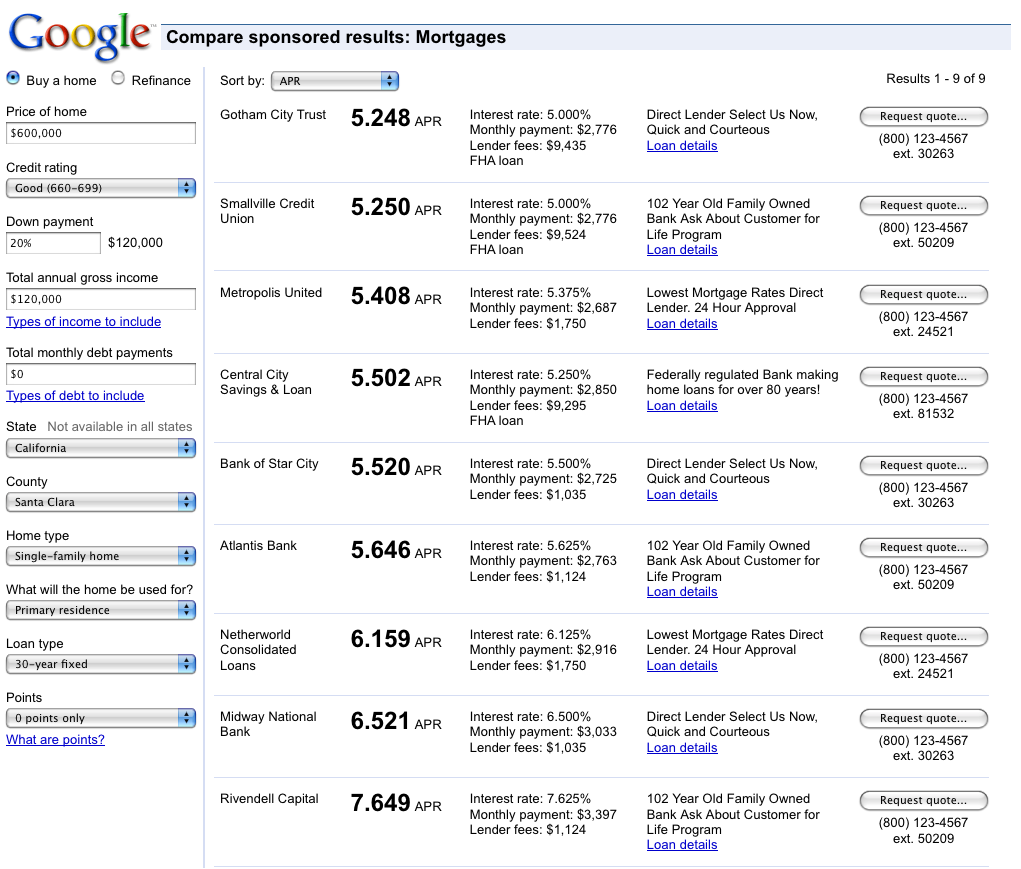
Still other ad formats may introduce new ways of presenting information, such as Comparison Ads, which allow you to specify exactly what you're looking for and to compare rates and prices in a single location. With the approaching new year comes resolutions to get things in order, so you might want an ad that lets you see side-by-side refinancing offers.

While we experiment with new formats, we'll remain loyal to our core principle: that getting the right ad to the right person at the right time matters. As we continue to think up innovative ways to give you the information you want, you’re likely to see even more ad formats until we pinpoint the most useful, relevant and engaging ones. We’ll keep trying new things until we discover the “perfect” ads that improve your overall search experience.
Text is often useful, but sometimes videos and pictures are a more effective way to receive information. For example, if you want to learn a magic trick, a video showing you how to perform the trick is likely the best result. So over the past few years, we've blended videos, images, maps and more into the search results on Google.com.
It also makes sense to provide you with richer types of information in the ads. If you're looking to buy your mom a new handbag for the holidays, for instance, you might want to see pictures, prices, the addresses of boutiques in your area and a map of how to get there — all within the ad.
To provide a better search ads experience, we've been developing and testing a variety of new ad formats. These formats are focused on giving you the information you need, while retaining what you love about Google advertising: that the ads are relevant and useful.
If you’re in the U.S. you may have already seen a number of these ad formats when searching on Google.
Some of them include visual elements. For example, if you’re curious about the movies that are playing this holiday season, you might see an ad with a video that lets you watch a trailer.

You might also see an ad with more links so you can quickly find a specific page in an advertiser’s website. If you're researching airfare to visit your relatives for the holidays, it saves time to go directly to Priceline's page about booking flights, rather than the general homepage or rental car page.

Or, if you’re trying to find a holiday bouquet to bring to your dinner party hostess, you might see an ad that shows your local florist's location on a map and provides driving directions.

Other new ad formats might help you find all the addresses and locations of a chain store in your area. So if you're vacationing abroad this season and have a craving for something familiar, the ad might show you all the nearby Pizza Huts that can deliver to your hotel.

And starting today, you might spot ads that include images and prices for specific products. When shopping for the ski outfit your nephew has been hinting about all year, you might see pictures from the retailer’s inventory to help you quickly determine if they have the color and style you had in mind.

Still other ad formats may introduce new ways of presenting information, such as Comparison Ads, which allow you to specify exactly what you're looking for and to compare rates and prices in a single location. With the approaching new year comes resolutions to get things in order, so you might want an ad that lets you see side-by-side refinancing offers.
While we experiment with new formats, we'll remain loyal to our core principle: that getting the right ad to the right person at the right time matters. As we continue to think up innovative ways to give you the information you want, you’re likely to see even more ad formats until we pinpoint the most useful, relevant and engaging ones. We’ll keep trying new things until we discover the “perfect” ads that improve your overall search experience.
Monday, November 23, 2009
Displaying the best display ad with Teracent


Can you spot the difference between these two sample display ads? Of course you can. However, the most important difference is not discernible to the naked eye.
The lower ad was customized and chosen from thousands of different creative elements, automatically and in real-time, by machine-learning algorithms developed by Teracent, a San Mateo, California startup.
We think that this technology has great potential to improve display advertising on the web. That's why we're pleased to announce today that we've entered into a definitive agreement to acquire Teracent. The transaction, which is subject to various closing conditions, is expected to close this quarter.
As you know, we've been busy releasing new features and products to help improve display advertising on the web for everyone. We believe that Teracent's technology fits neatly into these efforts.
Teracent's technology can pick and choose from literally thousands of creative elements of a display ad in real-time — tweaking images, products, messages or colors. These elements can be optimized depending on factors like geographic location, language, the content of the website, the time of day or the past performance of different ads.
This technology can help advertisers get better results from their display ad campaigns. In turn, this enables publishers to make more money from their ad space and delivers web users better ads and more ad-funded web content.
We're looking forward to welcoming the Teracent team to Google and to making this technology available to our display advertising clients — including those who run display ad campaigns on the Google Content Network and our DoubleClick clients.
Update on 12/11/2009: The deal has closed, and Teracent is officially part of Google.
Friday, October 30, 2009
Three contest winners making their way to television
(Cross-posted from the Google TV Ads Blog)
Small businesses often think that television advertising is too expensive and cumbersome for them to use. They assume that they need a fancy, expensive commercial to use in their TV campaign. But Google TV Ads changes all of that — we make it easy and affordable for you to make a TV ad, plan a campaign and reach your customers through the power of television. We launched the TV for All contest two months ago to prove just that.
More than 200 companies submitted commercials for the opportunity to win $25,000 worth of free national advertising on cable channels such as CNBC, Hallmark and Bloomberg using Google TV Ads. Today, we're happy to announce the three winners of the TV for All contest based on votes from the YouTube community.
Amazing Gates, Owners.com and ZAGG.com received the largest number of votes among the 10 finalists. Each of these businesses will receive $25,000 in free national advertising through Google TV Ads advertising.


Check out the three winners and all entries at www.youtube.com/tvforallcontest. For more information on Google TV Ads and how it can help your small business succeed, visit our website at google.com/tvads.
Small businesses often think that television advertising is too expensive and cumbersome for them to use. They assume that they need a fancy, expensive commercial to use in their TV campaign. But Google TV Ads changes all of that — we make it easy and affordable for you to make a TV ad, plan a campaign and reach your customers through the power of television. We launched the TV for All contest two months ago to prove just that.
More than 200 companies submitted commercials for the opportunity to win $25,000 worth of free national advertising on cable channels such as CNBC, Hallmark and Bloomberg using Google TV Ads. Today, we're happy to announce the three winners of the TV for All contest based on votes from the YouTube community.
Amazing Gates, Owners.com and ZAGG.com received the largest number of votes among the 10 finalists. Each of these businesses will receive $25,000 in free national advertising through Google TV Ads advertising.
Check out the three winners and all entries at www.youtube.com/tvforallcontest. For more information on Google TV Ads and how it can help your small business succeed, visit our website at google.com/tvads.
Wednesday, October 14, 2009
One-stop shop: Buy Promoted Videos in AdWords
We first launched Promoted Videos as a search advertising program on YouTube, allowing content creators to drive viewership of their videos by targeting the hundreds of millions of searches that happen on YouTube every day. But in the past year Promoted Videos has evolved into a much broader discovery vehicle, appearing on search, the YouTube homepage, video watch pages and recently across the AdSense network. We've also built better conversion opportunities via Call-to-Action overlays. As a result, Promoted Videos is now driving millions of video views per week, with clicks having increased 500% since January. In a world where 20 hours of video are uploaded to YouTube every minute, Promoted Videos has become a critical way for creators to get their content in front of viewers across the web.
Now that it's easier than ever to drive views of your video, we also wanted to make it easier to run these campaigns in the first place. Starting today you can buy Promoted Videos directly in AdWords. Any AdWords advertiser with video content — from a small business looking to promote a product, to a movie studio premiering a new trailer — can use Promoted Videos to make sure their videos find a larger audience. This integration will provide a single destination for your overall Google ad buy, and will give YouTube advertisers access to campaign tools in AdWords.
AdWords is a global platform, so we're excited to use this integration as a way to start rolling out Promoted Videos internationally. With this launch, Promoted Videos are now available in Canada, the U.K., France, Italy, Germany, Spain and the Netherlands. We hope our international users, partners and advertisers will take full advantage of this new opportunity to ensure their videos are more easily discovered around the world, and we look forward to expanding to other countries in the coming weeks.
Now that it's easier than ever to drive views of your video, we also wanted to make it easier to run these campaigns in the first place. Starting today you can buy Promoted Videos directly in AdWords. Any AdWords advertiser with video content — from a small business looking to promote a product, to a movie studio premiering a new trailer — can use Promoted Videos to make sure their videos find a larger audience. This integration will provide a single destination for your overall Google ad buy, and will give YouTube advertisers access to campaign tools in AdWords.
AdWords is a global platform, so we're excited to use this integration as a way to start rolling out Promoted Videos internationally. With this launch, Promoted Videos are now available in Canada, the U.K., France, Italy, Germany, Spain and the Netherlands. We hope our international users, partners and advertisers will take full advantage of this new opportunity to ensure their videos are more easily discovered around the world, and we look forward to expanding to other countries in the coming weeks.
Monday, October 5, 2009
AdSense for Mobile optimized for high-end phones
High-end mobile phones, like iPhone, Android-powered devices and the Palm Pre , continue to grow — Gartner estimates that global sales of smartphones will soar by 27% in 2009, to 177 million units. Naturally, as a result more and more people are browsing the web on the go.
Because these devices offer a browsing experience that is similar to desktop computers, advertising on smartphones is a natural extension for any AdWords campaign. However, it's not always been easy for advertisers to reach people on smartphones. That's why we're investing in new high-end mobile advertising products such as our search ad options for high-end phones and AdSense for mobile applications. We hope to make advertising on high-end mobile devices as intuitive, effective and user-friendly as our existing AdWords tools.
Today, we're excited to announce a new feature for our AdSense mobile publishers that enables them to serve text and image ads on their sites — specifically on these high-end smartphones. This helps mobile publishers earn revenue and fund more mobile-specific sites and web content.
New features like this help to nurture the smartphone ecosystem by encouraging the creation of more mobile content and by helping advertisers to grow their businesses by reaching new audiences. Our users' experience is also improved, with increasingly relevant and device-optimized mobile ads that load faster and fit better on small screens.
For more info about this feature, check out the Inside AdSense Blog.
Because these devices offer a browsing experience that is similar to desktop computers, advertising on smartphones is a natural extension for any AdWords campaign. However, it's not always been easy for advertisers to reach people on smartphones. That's why we're investing in new high-end mobile advertising products such as our search ad options for high-end phones and AdSense for mobile applications. We hope to make advertising on high-end mobile devices as intuitive, effective and user-friendly as our existing AdWords tools.
Today, we're excited to announce a new feature for our AdSense mobile publishers that enables them to serve text and image ads on their sites — specifically on these high-end smartphones. This helps mobile publishers earn revenue and fund more mobile-specific sites and web content.
New features like this help to nurture the smartphone ecosystem by encouraging the creation of more mobile content and by helping advertisers to grow their businesses by reaching new audiences. Our users' experience is also improved, with increasingly relevant and device-optimized mobile ads that load faster and fit better on small screens.
For more info about this feature, check out the Inside AdSense Blog.
Thursday, September 17, 2009
The DoubleClick Ad Exchange: growing the display advertising pie for everyone
Hundreds of thousands of advertisers use search advertising — short, highly relevant text ads alongside search results on Google and other search engines — to grow their businesses. Thanks to a decade of innovation, search advertising is an open platform that allows businesses to easily connect with customers.
As you browse the web today, you'll also see "display advertising," such as videos, images and interactive ads. Like search ads, these connect users with products, services and ideas that interest them. For advertisers, display ads are vital in boosting awareness and sales. For websites and online publishers, they help fund investments in online content and the web services that we all use.
But with a multitude of display ad formats, and thousands of websites, it often takes thousands of hours for advertisers to plan and manage their display ad campaigns. With this complexity, lots of advertisers today just don't bother, or don't invest as much as they would like.
On the other side of the equation, some publishers are left with up to 80% of their ad space unsold. It’s like airlines flying with their planes mostly empty. And for the ad space that they do sell, publishers also have to deal with the complexity of managing thousands of advertisers and campaigns.
We believe that a better system built on better technology can help grow the display advertising pie and benefit everyone.
Three principles underpin our approach to the display advertising field:
1. Simplify the system for buying and selling display ads: For example, our DoubleClick ad serving products help advertisers and publishers manage campaigns and ad formats across thousands of websites and from thousands of advertisers.
2. Deliver better performance that advertisers and agencies can measure: We're building a host of new features to help advertisers to run display ad campaigns across the Google Content Network (comprising hundreds of thousands of AdSense partner sites) and on YouTube. We're also developing better measurement and reporting technology so they can figure out what's working and what's not.
3. Open up the ecosystem: We want to democratize access to display advertising and make it accessible and open, like search advertising. We recently launched the Display Ad Builder to help businesses easily set up and run display ad campaigns. 80% of advertisers who use that product have never run a display ad campaign before.
We've been working hard to put these principles into practice, and today we're excited to announce the new DoubleClick Ad Exchange, a step towards creating a more open display advertising ecosystem for everyone. The Ad Exchange is a real-time marketplace that helps large online publishers on one side; and ad networks and agency networks on the other, buy and sell display advertising space.
These publishers and ad networks manage and represent large volumes of ads and ad space from lots of advertisers and websites. By bringing them together in an open marketplace in which prices are set in a real-time auction, the Ad Exchange enables display ads and ad space to be allocated much more efficiently. This improves returns for advertisers and enables publishers to get the most value out of their online content.
An explanation of the Ad Exchange is here (PDF). You can read in more detail about the features of the new DoubleClick Ad Exchange on the DoubleClick blog.
AdWords advertisers will be able to run ads on sites in the Ad Exchange, using their existing AdWords interface. This means more high quality sites for AdWords advertisers to run display ads on. Similarly, our AdSense publishers will benefit from more high-quality display advertisers coming through the Ad Exchange. You can read more about these benefits on the AdWords Blog and the AdSense Blog.
To find out more about our overall display advertising vision and the many services and features we've been investing in across the Google Content Network, YouTube and DoubleClick, check out the video below:
We believe that growing the display advertising pie for everyone will greatly enhance the web experience for advertisers, publishers, and ultimately users. The DoubleClick Ad Exchange will help create a more open marketplace and is a major step towards that vision.
As you browse the web today, you'll also see "display advertising," such as videos, images and interactive ads. Like search ads, these connect users with products, services and ideas that interest them. For advertisers, display ads are vital in boosting awareness and sales. For websites and online publishers, they help fund investments in online content and the web services that we all use.
But with a multitude of display ad formats, and thousands of websites, it often takes thousands of hours for advertisers to plan and manage their display ad campaigns. With this complexity, lots of advertisers today just don't bother, or don't invest as much as they would like.
On the other side of the equation, some publishers are left with up to 80% of their ad space unsold. It’s like airlines flying with their planes mostly empty. And for the ad space that they do sell, publishers also have to deal with the complexity of managing thousands of advertisers and campaigns.
We believe that a better system built on better technology can help grow the display advertising pie and benefit everyone.
Three principles underpin our approach to the display advertising field:
1. Simplify the system for buying and selling display ads: For example, our DoubleClick ad serving products help advertisers and publishers manage campaigns and ad formats across thousands of websites and from thousands of advertisers.
2. Deliver better performance that advertisers and agencies can measure: We're building a host of new features to help advertisers to run display ad campaigns across the Google Content Network (comprising hundreds of thousands of AdSense partner sites) and on YouTube. We're also developing better measurement and reporting technology so they can figure out what's working and what's not.
3. Open up the ecosystem: We want to democratize access to display advertising and make it accessible and open, like search advertising. We recently launched the Display Ad Builder to help businesses easily set up and run display ad campaigns. 80% of advertisers who use that product have never run a display ad campaign before.
We've been working hard to put these principles into practice, and today we're excited to announce the new DoubleClick Ad Exchange, a step towards creating a more open display advertising ecosystem for everyone. The Ad Exchange is a real-time marketplace that helps large online publishers on one side; and ad networks and agency networks on the other, buy and sell display advertising space.
These publishers and ad networks manage and represent large volumes of ads and ad space from lots of advertisers and websites. By bringing them together in an open marketplace in which prices are set in a real-time auction, the Ad Exchange enables display ads and ad space to be allocated much more efficiently. This improves returns for advertisers and enables publishers to get the most value out of their online content.
An explanation of the Ad Exchange is here (PDF). You can read in more detail about the features of the new DoubleClick Ad Exchange on the DoubleClick blog.
AdWords advertisers will be able to run ads on sites in the Ad Exchange, using their existing AdWords interface. This means more high quality sites for AdWords advertisers to run display ads on. Similarly, our AdSense publishers will benefit from more high-quality display advertisers coming through the Ad Exchange. You can read more about these benefits on the AdWords Blog and the AdSense Blog.
To find out more about our overall display advertising vision and the many services and features we've been investing in across the Google Content Network, YouTube and DoubleClick, check out the video below:
We believe that growing the display advertising pie for everyone will greatly enhance the web experience for advertisers, publishers, and ultimately users. The DoubleClick Ad Exchange will help create a more open marketplace and is a major step towards that vision.
Wednesday, September 16, 2009
New AdWords bidding tutorial
(Cross-posted from the Inside AdWords Blog)
Last month we launched a new feature of AdWords called Bid Simulator. Bid Simulator takes some of the guess work out of cost per click (CPC) bidding by estimating the number of clicks or impressions you could have received if you had used a different maximum CPC bid. Today, I thought I would take the opportunity to help you make the most of this new feature by explaining how to use the data from Bid Simulator to maximize the profit from your marketing investment.
In general, when you increase your maximum CPC bid for keywords on search you are able to generate more clicks to your site. This may be because your new bid qualifies you to appear higher up in the Sponsored Links on the search results page, or because your higher bid qualifies your ad to appear in new, more expensive auctions. The goal for you as an advertiser is to decide whether or not these additional clicks come at a cost that is still profitable for you.
To make this decision, you need to compare your expected value per click to your incremental cost per click. Your value per click is how much a click for a particular keyword is worth to you, on average. Your incremental cost per click is how much extra you are paying, on average, for the extra clicks you are getting from your higher bid. When your value per click is higher than your incremental cost per click it makes sense to increase your bid. On the other hand, if your value per click is lower than your incremental cost per click, you probably want to decrease your bid.
To learn more, you can watch the tutorial video below. In the video, I'll show you how to calculate these values, how to interpret them and how to use the data to maximize the profit from your marketing investment. My team and I are always looking for ways to help make the AdWords auction easier to understand so if you have other topics that you'd like us to address, please leave a comment on the video and we may be able to make it a topic for a future video.
Watch it on YouTube: http://www.youtube.com/watch?v=jRx7AMb6rZ0
Last month we launched a new feature of AdWords called Bid Simulator. Bid Simulator takes some of the guess work out of cost per click (CPC) bidding by estimating the number of clicks or impressions you could have received if you had used a different maximum CPC bid. Today, I thought I would take the opportunity to help you make the most of this new feature by explaining how to use the data from Bid Simulator to maximize the profit from your marketing investment.
In general, when you increase your maximum CPC bid for keywords on search you are able to generate more clicks to your site. This may be because your new bid qualifies you to appear higher up in the Sponsored Links on the search results page, or because your higher bid qualifies your ad to appear in new, more expensive auctions. The goal for you as an advertiser is to decide whether or not these additional clicks come at a cost that is still profitable for you.
To make this decision, you need to compare your expected value per click to your incremental cost per click. Your value per click is how much a click for a particular keyword is worth to you, on average. Your incremental cost per click is how much extra you are paying, on average, for the extra clicks you are getting from your higher bid. When your value per click is higher than your incremental cost per click it makes sense to increase your bid. On the other hand, if your value per click is lower than your incremental cost per click, you probably want to decrease your bid.
To learn more, you can watch the tutorial video below. In the video, I'll show you how to calculate these values, how to interpret them and how to use the data to maximize the profit from your marketing investment. My team and I are always looking for ways to help make the AdWords auction easier to understand so if you have other topics that you'd like us to address, please leave a comment on the video and we may be able to make it a topic for a future video.
Watch it on YouTube: http://www.youtube.com/watch?v=jRx7AMb6rZ0
Tuesday, August 4, 2009
Leave the math to us: Advertisers increase their profits using Conversion Optimizer
This post is the latest in an ongoing series on The Power of Measurement. Previous topics have covered ways to make your website as successful as possible through tools such as Analytics and Website Optimizer. – Ed.
If you're an old-school AdWords advertiser, you may remember that you originally set bids based on ad impressions (cost-per-impression, or CPM). Later, AdWords transitioned to a new model where bids were set based on ad clicks (cost-per-click, or CPC). Now, as technology has become even more advanced, we’re seeing the next phase of search engine advertising.
What if we told you that you could bid for ads simply based on conversions? (A conversion is a goal set by an advertiser, such as a website visitor purchasing a product or filling out a form.) With Conversion Optimizer, Google does all the heavy lifting and complicated analysis, letting you bid simply based on how much a conversion is worth to your business (cost-per-acquisition, or CPA). By using Conversion Optimizer, advertisers are not only seeing an increase in profits but have more time to devote to the rest of their business.
We’re excited to announce that this AdWords transformation is well underway: advertisers are already using the Conversion Optimizer to manage approximately $1 billion in spend annually.* This new shift benefits two areas Google cares deeply about: showing our users the most relevant ads and helping our advertisers increase their profits.
So how does it work? Each and every time someone types in a search query, AdWords runs a new keyword auction. Advertisers who are still bidding on a cost-per-click basis will be using the same bid in many different auctions, so sometimes their bid may be too high or too low. However, for advertisers using Conversion Optimizer, we'll automatically adjust the bid for each of these auctions so that it can hit the sweet spot more often, helping the advertiser to make more money.
For example, suppose you're advertising an online shoe store and you purchase ads using the keyword "shoes." Because your clicks come from many different types of people who have different intentions, Conversion Optimizer takes many factors into account to optimize your ad performance. If you don't ship internationally, Conversion Optimizer will learn that clicks from international users don't convert and will eliminate traffic from outside the United States. It might also learn that when customers include the word "cheap" in their query, they are particularly likely to convert because your prices are very competitive. Essentially, Google does the detective work — you tell us how much a conversion is worth and our algorithms make it happen.
As more advertisers transition to Conversion Optimizer, we look forward to showing more relevant ads and, in doing so, helping our advertisers achieve better results. Learn more about Conversion Optimizer and get started using it with your AdWords campaigns.
* Annualized figures based on Q2 sales
If you're an old-school AdWords advertiser, you may remember that you originally set bids based on ad impressions (cost-per-impression, or CPM). Later, AdWords transitioned to a new model where bids were set based on ad clicks (cost-per-click, or CPC). Now, as technology has become even more advanced, we’re seeing the next phase of search engine advertising.
What if we told you that you could bid for ads simply based on conversions? (A conversion is a goal set by an advertiser, such as a website visitor purchasing a product or filling out a form.) With Conversion Optimizer, Google does all the heavy lifting and complicated analysis, letting you bid simply based on how much a conversion is worth to your business (cost-per-acquisition, or CPA). By using Conversion Optimizer, advertisers are not only seeing an increase in profits but have more time to devote to the rest of their business.
We’re excited to announce that this AdWords transformation is well underway: advertisers are already using the Conversion Optimizer to manage approximately $1 billion in spend annually.* This new shift benefits two areas Google cares deeply about: showing our users the most relevant ads and helping our advertisers increase their profits.
So how does it work? Each and every time someone types in a search query, AdWords runs a new keyword auction. Advertisers who are still bidding on a cost-per-click basis will be using the same bid in many different auctions, so sometimes their bid may be too high or too low. However, for advertisers using Conversion Optimizer, we'll automatically adjust the bid for each of these auctions so that it can hit the sweet spot more often, helping the advertiser to make more money.
For example, suppose you're advertising an online shoe store and you purchase ads using the keyword "shoes." Because your clicks come from many different types of people who have different intentions, Conversion Optimizer takes many factors into account to optimize your ad performance. If you don't ship internationally, Conversion Optimizer will learn that clicks from international users don't convert and will eliminate traffic from outside the United States. It might also learn that when customers include the word "cheap" in their query, they are particularly likely to convert because your prices are very competitive. Essentially, Google does the detective work — you tell us how much a conversion is worth and our algorithms make it happen.
As more advertisers transition to Conversion Optimizer, we look forward to showing more relevant ads and, in doing so, helping our advertisers achieve better results. Learn more about Conversion Optimizer and get started using it with your AdWords campaigns.
* Annualized figures based on Q2 sales
Thursday, July 23, 2009
Announcing the 2009 Google Online Marketing Challenge winners
This year we held the second Google Online Marketing Challenge — a global university competition, launched last year, that gives undergraduate and post-graduate students hands-on exposure to online marketing. Working with their professors, teams receive the equivalent of US$200 to spend on Google AdWords advertising, then work with a local business to devise an effective online marketing campaign. Teams are given three weeks to mastermind the strategy before submitting a campaign report to an international judging panel of professors.
This year's Challenge was bigger and better in every way — more teams, more students, more universities and a significant improvement in the quality of campaigns and reports. We're thrilled to report that 2,187 teams took part from across 57 countries, representing a 36% increase in participation from last year. The Challenge continues to develop as one of the world’s biggest university competitions.
We're excited today to announce the results. Our global winners come from Deakin University, Australia and were taught by Chia Yao Lee and Bardo Fraunholz. The team of Andrew Kidd, Richard Blakely, Kevin Fung, Clinton Hinze, Katalin Kish and Howard Lien worked with a local kids play center, www.littletigrrs.com.au, to create a well-crafted campaign that highly impressed our judges.

Team spokesman Andrew Kidd gave us some insight into their winning campaign:
There were also three regional winners: for the Americas, the winning team comes from James Madison University in the U.S., while a team from the Warsaw School of Economics in Poland won for Europe, the Middle East and Africa. In the Asia Pacific region, the winners come from the International College of Management in Sydney, Australia. Here are more details about our winners.
We developed the Challenge to benefit everyone involved. We're delighted that thousands of small businesses around the world have seen their online presence improved in just three weeks. Professors tell us that the Challenge has allowed them to deliver a unique, practical teaching and learning exercise. For those students that took part, we hope they have developed some useful online marketing skills which they can use when they graduate and enter the workforce.
For anyone interested in competing in the 2010 Challenge, formal registrations will open later this year, but in the meantime you can register your interest.
This year's Challenge was bigger and better in every way — more teams, more students, more universities and a significant improvement in the quality of campaigns and reports. We're thrilled to report that 2,187 teams took part from across 57 countries, representing a 36% increase in participation from last year. The Challenge continues to develop as one of the world’s biggest university competitions.
We're excited today to announce the results. Our global winners come from Deakin University, Australia and were taught by Chia Yao Lee and Bardo Fraunholz. The team of Andrew Kidd, Richard Blakely, Kevin Fung, Clinton Hinze, Katalin Kish and Howard Lien worked with a local kids play center, www.littletigrrs.com.au, to create a well-crafted campaign that highly impressed our judges.

Clockwise from top left: Richard Blakely, Chia Yao Lee (professor), Katalin Kish, Kevin Fung, Bardo Fraunholz (professor), Howard Lien, Andrew Kidd, Fiona and Mike (from Little Tigrrs), Clinton Hinze and Mick, The Big Hearted Tiger
Team spokesman Andrew Kidd gave us some insight into their winning campaign:
"After discussions with the business owners, we decided we needed to conduct three separate campaigns. One would promote the play center to customers outside a 10 kilometre geographic radius, another would attract more mothers' groups to the center, and the third one would attract more party and group event bookings. Visitors to their website more than doubled compared with the same period last year. We knew we had developed a strong campaign — but to win the global competition is outstanding."The team and their professor are off to Mountain View, California for a tour of the Googleplex. To help in their ongoing studies, each team member will also receive an Apple MacBook Pro.
There were also three regional winners: for the Americas, the winning team comes from James Madison University in the U.S., while a team from the Warsaw School of Economics in Poland won for Europe, the Middle East and Africa. In the Asia Pacific region, the winners come from the International College of Management in Sydney, Australia. Here are more details about our winners.
We developed the Challenge to benefit everyone involved. We're delighted that thousands of small businesses around the world have seen their online presence improved in just three weeks. Professors tell us that the Challenge has allowed them to deliver a unique, practical teaching and learning exercise. For those students that took part, we hope they have developed some useful online marketing skills which they can use when they graduate and enter the workforce.
For anyone interested in competing in the 2010 Challenge, formal registrations will open later this year, but in the meantime you can register your interest.
Wednesday, June 24, 2009
Announcing the AdSense for Mobile Applications beta
You don't have to be a mobile expert to see how smartphones are revolutionizing our daily lives. Lower prices, faster network speeds and unlimited data plans mean that people often reach for their cell phone rather than their computer when they are seeking information. As a result, mobile applications have become more and more popular, helping people find music, make restaurant reservations or check bank balances — all on their phone.
We want to contribute to the growth of these mobile applications, which is why we're happy to announce our beta launch of AdSense for Mobile Applications. After all, advertisers are looking for ways to reach potential customers when they are engaged with mobile content, and application developers are looking for ways to show the best ads to their users. We have already had a successful trial of this service with a small number of partners, and are excited that we can now offer this solution to a broader group.
AdSense for Mobile Applications allows developers to earn revenue by displaying text and image ads in their iPhone and Android applications. For our beta launch, we've created a site where developers can learn more about the AdSense for Mobile Applications program, see answers to frequently asked questions and sign up to participate in our beta. Advertisers can also learn about the benefits of advertising in mobile applications.
We're excited to open up this beta to more developers, and look forward to offering new features for our mobile advertisers and publishers in upcoming releases. We also want to say a big thank you to the partners who worked with us on the trial stages of this project including Backgrounds, Sega, Shazam, Urbanspoon and more.
Check out this short video of Howard Steinberg, Director of Business Development at Urbanspoon, discussing his experience with AdSense for Mobile Applications.
We want to contribute to the growth of these mobile applications, which is why we're happy to announce our beta launch of AdSense for Mobile Applications. After all, advertisers are looking for ways to reach potential customers when they are engaged with mobile content, and application developers are looking for ways to show the best ads to their users. We have already had a successful trial of this service with a small number of partners, and are excited that we can now offer this solution to a broader group.
AdSense for Mobile Applications allows developers to earn revenue by displaying text and image ads in their iPhone and Android applications. For our beta launch, we've created a site
We're excited to open up this beta to more developers, and look forward to offering new features for our mobile advertisers and publishers in upcoming releases. We also want to say a big thank you to the partners who worked with us on the trial stages of this project including Backgrounds, Sega, Shazam, Urbanspoon and more.
Check out this short video of Howard Steinberg, Director of Business Development at Urbanspoon, discussing his experience with AdSense for Mobile Applications.
Friday, May 8, 2009
Google Chrome ads on TV
A couple of months ago, the Google Japan team produced a fun video to demonstrate how clean and simple our Google Chrome user interface is. After releasing this video on the web, we got lots of positive feedback and thoughtful comments. In order to keep that conversation going, we invited some of our creative friends to make a collection of short films celebrating our browser. We released Chrome Shorts last week on our YouTube channel.
At the same time, we talked to our Google TV Ads team to see how we could show the video that our Japan team developed to a wider audience in a measurable way. Using some of the results from our placement-targeted ads on the Google Content Network, we designed a Google TV Ads campaign which we hope will raise awareness of our browser, and also help us better understand how television can supplement our other online media campaigns.
So today, we’re pleased to announce that we're using Google TV Ads to run our Chrome ad on various television networks starting this weekend. We're excited to see how this test goes and what impact television might have on creating more awareness of Google Chrome.
Check out the video below if you haven’t already seen it, or wait and you might see it on TV while you’re channel surfing!
At the same time, we talked to our Google TV Ads team to see how we could show the video that our Japan team developed to a wider audience in a measurable way. Using some of the results from our placement-targeted ads on the Google Content Network, we designed a Google TV Ads campaign which we hope will raise awareness of our browser, and also help us better understand how television can supplement our other online media campaigns.
So today, we’re pleased to announce that we're using Google TV Ads to run our Chrome ad on various television networks starting this weekend. We're excited to see how this test goes and what impact television might have on creating more awareness of Google Chrome.
Check out the video below if you haven’t already seen it, or wait and you might see it on TV while you’re channel surfing!
Thursday, April 30, 2009
What's a rich media ad, anyway?
Since last year's DoubleClick acquisition, we've increased our focus on helping marketers and agencies use Google tools for all of their display advertising needs. DoubleClick Rich Media is the part of DoubleClick that provides the technology for the most technically advanced and engaging of these display ads, which are typically created by creative agencies for their brand-focused clients. To help make this process even easier and efficient, today we're launching DoubleClick Studio, our new rich media production and development tool.
To describe rich media, it helps to think about other ad formats that we're all familiar with, starting with the simplest: text ads. With just a few keystrokes, anyone can create simple messages in a standardized format, and place them on a site like Google.com in minutes. Then we have standard display ads, ads that usually include text with a visual such as a logo or a graphic. These can be in formats we're all familiar with like .jpg, .gif, .swf and more. Standard display ads can either be static or animated with tools like Flash. They typically have only one interaction, meaning that when you click on them, you'll be taken to a destination site. And then at the most complex level, from a design and interaction perspective, we have rich media ads. With rich media, you can have ads that expand when users click or roll over, for example, and there are extensive possibilities for interactive content, such as HD video or even the ability to click to make a phone call.
But making a rich media ad possible requires much more complex technology to ensure that all of the ad behaviors function properly, that all of the interactions can be measured, and to serve the ads onto web pages. Every piece of the canvas, from the video play button to the button that allows for expansion, requires coding in Flash that's made possible by a rich media technology provider like DoubleClick Rich Media. With all of this complexity, there's also a lot of room for error. So in addition to enabling the development of the ads, tools like DoubleClick Studio provide quality analysis and preview functionalities to make sure that the ads work the way they should.
Here is a graphic that represents some of the differences between types of online ads:
 With DoubleClick Studio, we hope to make it easier for our existing users to produce rich media ads, and to expand the number of advertisers that can make these useful formats part of their marketing strategy. This is also a good thing for Internet users; rich media capabilities make advertising even more useful, letting a viewer interact with an ad and learn about a brand without having to leave the page they're on. And, advertisers have an expanded creative canvas within the ad itself, allowing for deeper, higher-quality content in the ad itself. At Google, we believe that ads at their best are useful information.
To read more about DoubleClick Studio, visit the DoubleClick blog.
To describe rich media, it helps to think about other ad formats that we're all familiar with, starting with the simplest: text ads. With just a few keystrokes, anyone can create simple messages in a standardized format, and place them on a site like Google.com in minutes. Then we have standard display ads, ads that usually include text with a visual such as a logo or a graphic. These can be in formats we're all familiar with like .jpg, .gif, .swf and more. Standard display ads can either be static or animated with tools like Flash. They typically have only one interaction, meaning that when you click on them, you'll be taken to a destination site. And then at the most complex level, from a design and interaction perspective, we have rich media ads. With rich media, you can have ads that expand when users click or roll over, for example, and there are extensive possibilities for interactive content, such as HD video or even the ability to click to make a phone call.
But making a rich media ad possible requires much more complex technology to ensure that all of the ad behaviors function properly, that all of the interactions can be measured, and to serve the ads onto web pages. Every piece of the canvas, from the video play button to the button that allows for expansion, requires coding in Flash that's made possible by a rich media technology provider like DoubleClick Rich Media. With all of this complexity, there's also a lot of room for error. So in addition to enabling the development of the ads, tools like DoubleClick Studio provide quality analysis and preview functionalities to make sure that the ads work the way they should.
Here is a graphic that represents some of the differences between types of online ads:
 With DoubleClick Studio, we hope to make it easier for our existing users to produce rich media ads, and to expand the number of advertisers that can make these useful formats part of their marketing strategy. This is also a good thing for Internet users; rich media capabilities make advertising even more useful, letting a viewer interact with an ad and learn about a brand without having to leave the page they're on. And, advertisers have an expanded creative canvas within the ad itself, allowing for deeper, higher-quality content in the ad itself. At Google, we believe that ads at their best are useful information.
To read more about DoubleClick Studio, visit the DoubleClick blog.
Wednesday, April 8, 2009
Click-to-Buy expands to 8 new countries
Whether you come to YouTube to watch a specific video, discover related content, or engage and interact with people and videos from all around the world, our goal is to put you in control of your online video experience. This means making it easier for you to find what you're looking for (like dedicated channels for music or HD videos) and offering you new and innovative ways to engage with that content.
One way we already offer you this kind of deeper experience on YouTube involves music videos on the site: Click-to-Buy, our eCommerce platform, helps you find products (like songs and DVDs) related to the videos that you're watching. A recent study found that after watching a music video on YouTube, 50% of adult users in the U.K. then go on to purchase music from that artist. And we've seen these results for ourselves — three of the four major music labels are Click-to-Buy partners and are already selling millions of songs a year from these links on YouTube.
We're excited to announce that today we're rolling out Click-to-Buy links on music videos in 8 additional countries: Australia, Canada, France, Ireland, Italy, Japan, New Zealand, and Sweden. Now Click-to-Buy partners can offer music downloads to hundreds of millions of people around the world.
We enjoy working with our music partners to provide them with these kinds of opportunities, and we look forward to further expanding the program in the coming months.
One way we already offer you this kind of deeper experience on YouTube involves music videos on the site: Click-to-Buy, our eCommerce platform, helps you find products (like songs and DVDs) related to the videos that you're watching. A recent study found that after watching a music video on YouTube, 50% of adult users in the U.K. then go on to purchase music from that artist. And we've seen these results for ourselves — three of the four major music labels are Click-to-Buy partners and are already selling millions of songs a year from these links on YouTube.
We're excited to announce that today we're rolling out Click-to-Buy links on music videos in 8 additional countries: Australia, Canada, France, Ireland, Italy, Japan, New Zealand, and Sweden. Now Click-to-Buy partners can offer music downloads to hundreds of millions of people around the world.
We enjoy working with our music partners to provide them with these kinds of opportunities, and we look forward to further expanding the program in the coming months.
Tuesday, March 31, 2009
Analytics in Latin America
If you run an e-commerce site or use AdWords to direct traffic to your business' webpage, chances are you're interested in knowing what visitors to your site are clicking on, what content interests these potential customers and what avenues brought them there. The more you know about how people engage with your site, the better you are able to design successful advertising campaigns to help grow your business.
In Latin America, online advertising is growing as more and more small businesses initiate an online presence and publicize their efforts through search and display advertising. But less than 5% of web properties throughout Latin America rely on analysis tools to improve their website's performance. Last week, our offices throughout the region hosted several Analytics-themed events to give agencies and other clients a better look at several Google measurement tools that provide people with the means to analyze their site's flow of data, interest and readership in order to build a better advertising campaign.
In Mexico City, advertisers got together to learn about Insights for Search, Ad Planner, YouTube Insights, Analytics, Sitemaps and Website Optimizer, as well as DoubleClick tools. Presentations were designed to give companies an in-depth look at the Google tools that can be helpful for planning their marketing budgets during an economic downturn. Being able to measure data on what content interests people and where consumers are searching for information can help advertisers be more selective about how they invest ad budget. Since the great majority of consumers go online for information before making a purchase, the goal of the seminar was to familiarize advertisers with tools that can increase the reach of their campaigns, while giving them a better idea of what works and what people are searching for.
Meanwhile, our Analytics guru Avinash Kaushik visited São Paulo and Buenos Aires to speak to clients about web analytics and how to make the most of online marketing through analyzing metrics (check out his recent post on bounce rate for related information). Avinash made web analytics fun and accessible with colloquial comparisons (referring sites as 'BFFs'), and demonstrated how to optimize a website's performance with changes in color and layout, among other things. He was accompanied by Google's Latin America managing director Alexandre Hohagen, Brazil's country manager Alex Dias, and Argentina's country manager Adriana Noreña at a succession of events revolving around web metrics and website optimization.
The response and interest from customers and agencies to all of these events was indicative of the huge need for metrics and the ability to track ROI for their marketing investments, especially during these difficult times. For more information on Google Analytics tools, check out the Google Analytics Blog, the Website Optimizer Blog and the Conversion Room blog.
In Latin America, online advertising is growing as more and more small businesses initiate an online presence and publicize their efforts through search and display advertising. But less than 5% of web properties throughout Latin America rely on analysis tools to improve their website's performance. Last week, our offices throughout the region hosted several Analytics-themed events to give agencies and other clients a better look at several Google measurement tools that provide people with the means to analyze their site's flow of data, interest and readership in order to build a better advertising campaign.
In Mexico City, advertisers got together to learn about Insights for Search, Ad Planner, YouTube Insights, Analytics, Sitemaps and Website Optimizer, as well as DoubleClick tools. Presentations were designed to give companies an in-depth look at the Google tools that can be helpful for planning their marketing budgets during an economic downturn. Being able to measure data on what content interests people and where consumers are searching for information can help advertisers be more selective about how they invest ad budget. Since the great majority of consumers go online for information before making a purchase, the goal of the seminar was to familiarize advertisers with tools that can increase the reach of their campaigns, while giving them a better idea of what works and what people are searching for.
Meanwhile, our Analytics guru Avinash Kaushik visited São Paulo and Buenos Aires to speak to clients about web analytics and how to make the most of online marketing through analyzing metrics (check out his recent post on bounce rate for related information). Avinash made web analytics fun and accessible with colloquial comparisons (referring sites as 'BFFs'), and demonstrated how to optimize a website's performance with changes in color and layout, among other things. He was accompanied by Google's Latin America managing director Alexandre Hohagen, Brazil's country manager Alex Dias, and Argentina's country manager Adriana Noreña at a succession of events revolving around web metrics and website optimization.
The response and interest from customers and agencies to all of these events was indicative of the huge need for metrics and the ability to track ROI for their marketing investments, especially during these difficult times. For more information on Google Analytics tools, check out the Google Analytics Blog, the Website Optimizer Blog and the Conversion Room blog.
Thursday, March 12, 2009
Introduction to the ad auction
(Cross-posted from the Inside AdWords Blog)
When we go to conferences or read posts in forums, we find that advertisers sometimes know more about advanced features than about the basics of how AdWords works. So, we've decided to take some time to get back to basics and talk about how the AdWords auction actually works. To help you, we've brought along our Chief Economist, Hal Varian, to walk you through the auction and explain how your maximum cost-per-click (CPC) bid and Quality Score determine how much you actually pay for an ad click on Google's search results pages.
When people think of an auction, they often think of a prize being sold for the highest bid. But the AdWords auction works a little differently, where the winner only pays the minimum amount necessary to maintain their position on the page. That means you'll only pay the minimum necessary to beat the person below you. In fact, our quality-based pricing system ensures that you'll often pay less than your maximum bid.
How exactly does this work? We'll leave that to Hal to explain.
If you have trouble viewing this video, you can watch it here.
When we go to conferences or read posts in forums, we find that advertisers sometimes know more about advanced features than about the basics of how AdWords works. So, we've decided to take some time to get back to basics and talk about how the AdWords auction actually works. To help you, we've brought along our Chief Economist, Hal Varian, to walk you through the auction and explain how your maximum cost-per-click (CPC) bid and Quality Score determine how much you actually pay for an ad click on Google's search results pages.
When people think of an auction, they often think of a prize being sold for the highest bid. But the AdWords auction works a little differently, where the winner only pays the minimum amount necessary to maintain their position on the page. That means you'll only pay the minimum necessary to beat the person below you. In fact, our quality-based pricing system ensures that you'll often pay less than your maximum bid.
How exactly does this work? We'll leave that to Hal to explain.
If you have trouble viewing this video, you can watch it here.
Wednesday, March 11, 2009
Making ads more interesting
At Google, we believe that ads are a valuable source of information — one that can connect people to the advertisers offering products, services and ideas that interest them. By making ads more relevant, and improving the connection between advertisers and our users, we can create more value for everyone. Users get more useful ads, and these more relevant ads generate higher returns for advertisers and publishers. Advertising is the lifeblood of the digital economy: it helps support the content and services we all enjoy for free online today, including much of our news, search, email, video and social networks.
That's why Google has worked hard to create technology that makes the advertising on our own sites, and those of our partners, as relevant as possible. To date, we have shown ads based mainly on what your interests are at a specific moment. So if you search for [digital camera] on Google, you'll get ads related to digital cameras. If you are visiting the website of one of our AdSense partners, you would see ads based on the content of the page. For example, if you're reading a sports page on a newspaper website, we might show ads for running shoes. Or we can show ads for home maintenance services alongside a YouTube video instructing you on how to perform a simple repair. There are some situations, however, where a keyword or the content of a web page simply doesn't give us enough information to serve highly relevant ads.
We think we can make online advertising even more relevant and useful by using additional information about the websites people visit. Today we are launching "interest-based" advertising as a beta test on our partner sites and on YouTube. These ads will associate categories of interest — say sports, gardening, cars, pets — with your browser, based on the types of sites you visit and the pages you view. We may then use those interest categories to show you more relevant text and display ads.
We believe there is real value to seeing ads about the things that interest you. If, for example, you love adventure travel and therefore visit adventure travel sites, Google could show you more ads for activities like hiking trips to Patagonia or African safaris. While interest-based advertising can infer your interest in adventure travel from the websites you visit, you can also choose your favorite categories, or tell us which categories you don't want to see ads for. Interest-based advertising also helps advertisers tailor ads for you based on your previous interactions with them, such as visits to their websites. So if you visit an online sports store, you may later be shown ads on other websites offering you a discount on running shoes during that store's upcoming sale.
Our advertisers and publisher partners have been asking us for a long time to offer interest-based advertising. Advertisers need an efficient way to reach those who are most interested in their products and services. And publishers can generate more revenue when they connect advertisers to interested audiences.
This kind of tailored advertising does raise questions about user choice and privacy — questions the whole online ad industry has a responsibility to answer. Many companies already provide interest-based advertising and they address these issues in different ways. For our part, we're launching interest-based advertising with three important features that demonstrate our commitment to transparency and user choice.
Keyword advertising has been so successful because it's useful to users, advertisers and publishers — everyone's interests are aligned. We believe that interest-based ads will create the same virtuous cycle, by giving users more relevant ads, while generating higher returns for advertisers and publishers.
That's why Google has worked hard to create technology that makes the advertising on our own sites, and those of our partners, as relevant as possible. To date, we have shown ads based mainly on what your interests are at a specific moment. So if you search for [digital camera] on Google, you'll get ads related to digital cameras. If you are visiting the website of one of our AdSense partners, you would see ads based on the content of the page. For example, if you're reading a sports page on a newspaper website, we might show ads for running shoes. Or we can show ads for home maintenance services alongside a YouTube video instructing you on how to perform a simple repair. There are some situations, however, where a keyword or the content of a web page simply doesn't give us enough information to serve highly relevant ads.
We think we can make online advertising even more relevant and useful by using additional information about the websites people visit. Today we are launching "interest-based" advertising as a beta test on our partner sites and on YouTube. These ads will associate categories of interest — say sports, gardening, cars, pets — with your browser, based on the types of sites you visit and the pages you view. We may then use those interest categories to show you more relevant text and display ads.
We believe there is real value to seeing ads about the things that interest you. If, for example, you love adventure travel and therefore visit adventure travel sites, Google could show you more ads for activities like hiking trips to Patagonia or African safaris. While interest-based advertising can infer your interest in adventure travel from the websites you visit, you can also choose your favorite categories, or tell us which categories you don't want to see ads for. Interest-based advertising also helps advertisers tailor ads for you based on your previous interactions with them, such as visits to their websites. So if you visit an online sports store, you may later be shown ads on other websites offering you a discount on running shoes during that store's upcoming sale.
Our advertisers and publisher partners have been asking us for a long time to offer interest-based advertising. Advertisers need an efficient way to reach those who are most interested in their products and services. And publishers can generate more revenue when they connect advertisers to interested audiences.
This kind of tailored advertising does raise questions about user choice and privacy — questions the whole online ad industry has a responsibility to answer. Many companies already provide interest-based advertising and they address these issues in different ways. For our part, we're launching interest-based advertising with three important features that demonstrate our commitment to transparency and user choice.
- Transparency - We already clearly label most of the ads provided by Google on the AdSense partner network and on YouTube. You can click on the labels to get more information about how we serve ads, and the information we use to show you ads. This year we will expand the range of ad formats and publishers that display labels that provide a way to learn more and make choices about Google's ad serving.
- Choice - We have built a tool called Ads Preferences Manager, which lets you view, delete, or add interest categories associated with your browser so that you can receive ads that are more interesting to you.
- Control - You can always opt out of the advertising cookie for the AdSense partner network here. To make sure that your opt-out decision is respected (and isn't deleted if you clear the cookies from your browser), we have designed a plug-in for your browser that maintains your opt-out choice.
Keyword advertising has been so successful because it's useful to users, advertisers and publishers — everyone's interests are aligned. We believe that interest-based ads will create the same virtuous cycle, by giving users more relevant ads, while generating higher returns for advertisers and publishers.
Subscribe to:
Posts (Atom)